Understanding what Radon is?
The breakdown of uranium, radioactive elements, and radium found in soil, water, and rocks naturally forms radon, an unseen and tasteless, and odorless gas. Uranium naturally decays over time and makes radium, which in turn produces radon gas through radioactive decay. This is the first step in the formation of radon. So if you are thinking, where does radon come from? The quick answer is that uranium is naturally found in soil, almost any type of soil can contain this radioactive gas that undergoes decomposition and turns to radon. Where your home connects to the earth, there may be a tiny pore or opening that becomes a pathway of radon to enter your home.
Although radon can be found in all soil types, this does not imply that radon levels are high throughout the country. Because of the kind of soil, the presence of uranium in the soil, and other local factors, radon levels vary throughout the country. If you’re wondering what radon gas do once it forms, the easy answer is that if the levels are high in your house, you and your family are at potential risk for health issues.
Does Radon Levels vary widely across the Country?
According to research, one out of every fifteen residences in the United States has experienced elevated radon levels, which vary greatly by state. This means that regardless of the type of property or its location, radon problems can exist in any state in the United States. No matter how old or new your house is, how well-sealed it is, or how drafty it is, radon levels may still be elevated.
It’s a common misconception that radon just affects homes with basements; despite this, homes without basements can still have radon issues. It is false that a house without a basement cannot have a radon issue. There are various entry points for residential radon in any home, including tiny pores. There may be a little opening, a basement, no basement, gaps, or cracks where your living area is connected to the ground, it becomes an entry point for radon. Knowing how radon penetrates residential buildings helps explain why radon levels vary across the country and why all homes, schools, offices, even those buildings that seem well-built and sealed, should have high levels.
What is the pathway of Radon from the ground into my house?
The next step is to understand where radon enters home and how these pathways allow radon exposure to increase inside living spaces. Radon can easily find a way through the surrounding soil to enter your home and reach your living area. Radon can enter almost any type of home, including new and old homes, homes on slabs, homes with crawl spaces, homes with basements, and homes with crawl spaces. Gaps, joints, openings around pipes, cracks, and other locations where the house foundation meets the earth are typically the radon entrance points.
Radon Does Not Need a Large Visible Opening?
Radon gas does not need a large visible opening to move into your living area. Radon in soil gas can easily move through small cracks and holes when your home’s pressure differences allow it to enter indoors. Homeowners often worry about how radon enters through small cracks and how can radon come through concrete? Small foundation cracks, sump pits, gaps around pipes, construction joints, and floor drains can all become pathways for radon entering home.
These small entry points also solve the confusion most people have, like how does radon enter a basement, how does radon get into the basement, and how does radon enter through the floor. Radon gas can move from soil beneath the home through sump pits and other small openings. The same concern applies to crawl spaces, where soil gas can move indoors. Small cracks, floor drains, sump pits, and crawl spaces can all provide pathways for radon to move from the soil into a home. Understanding these potential entry points makes it easier to see how radon can enter a house and why checking areas around the foundation is important.
How Does Radon Get Into Your Home?
As Radon Gas can directly seep through soil, rock, or underground water and find a way to your living space through cracks, other openings, and gaps, close to the foundation. These holes let the gas go from the ground to the house and subsequently into the indoor air, where it may gradually accumulate over time. As we cannot see, notice, taste, or smell it, understanding these entry points is the crucial first step. The second important step is to properly test your home, which is the most dependable method of figuring out whether excessive levels are present and a reduction system is needed or not.
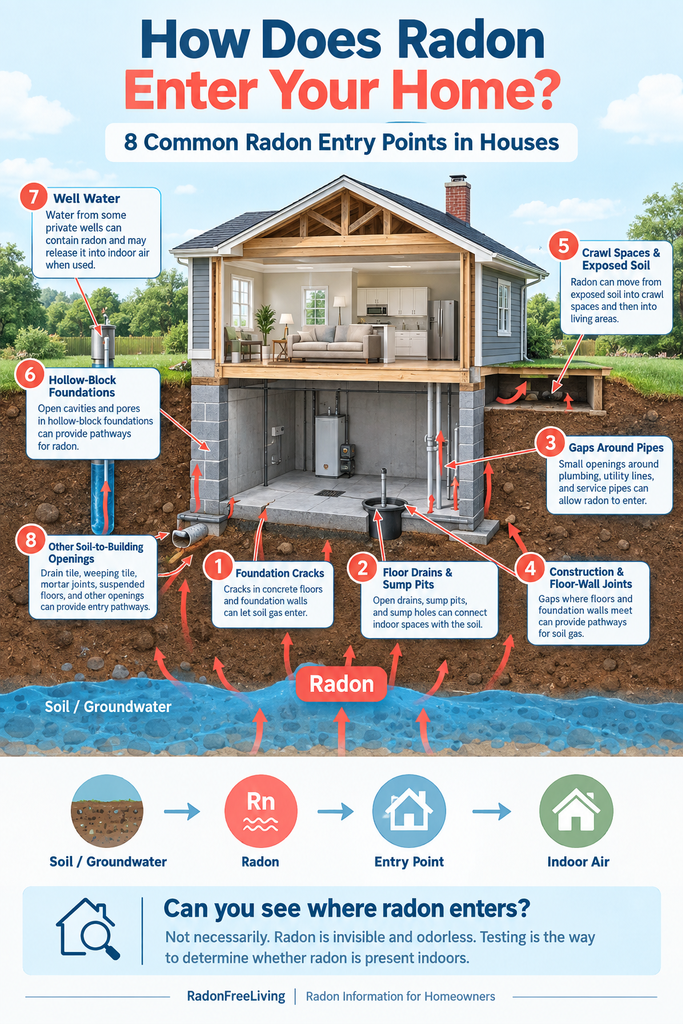
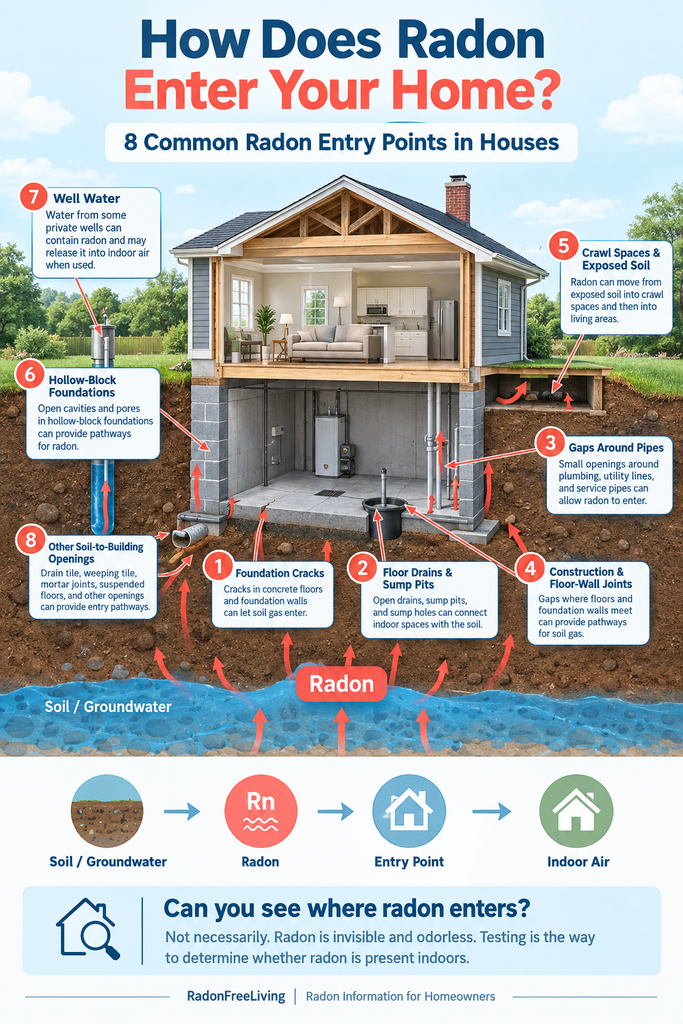
Radon Entry Points
- Cracks in Concrete Floors and Foundation Walls
Cracks in concrete floors and foundation walls can create pathways for soil gas to move into the home easily. Homeowners often How radon enters through foundation cracks so cracks in the concrete floor provide a direct pathway to Radon. - Floor Drains and Sump Pits
Floor drains, sump pits, open sumps, and sump holes can provide direct openings between the soil and indoor spaces you’re living. These holes can become vital radon entry points, especially in basements. - Gaps Around Pipes and Utility Lines
Loose-fitting of pipe penetrations and other gaps around service pipes and utility lines can allow radon gas to enter. Even small openings close to pipes are easy pathways for soil gas. - Construction Joints and Floor-Wall Joints
Construction joints, floor-wall joints, and other gaps in the foundation can be an entry point for soil gas to come indoors. These little pathways can be easily overlooked during a visual inspection rather than professional testing. - Crawl Spaces and Exposed Soil
Houses with crawl spaces may have exposed soil beneath home buildings. Radon can come from this soil into the crawl space and finally into your living areas. - Hollow-Block Walls and Foundations
Hollow-block walls, uncapped hollow-block foundations, cavities, and pores in concrete blocks can be easy and direct pathways for radon to move through foundation materials. - Well Water in Some Situations
Private wells and groundwater may have waterborne radon. If you are using well water in your home, radon can potentially enter indoor air when the water is used for home activities such as showering or washing. - Other Openings Between the Building and Soil
Suspended floors, weeping tile, drain tile, mortar joints, open tops, and other spaces between the building and soil can also become easy pathways for radon entry.
Conclusion
Radon cannot be seen, smelled, or tasted, and the foundation appearance of your home cannot reliably tell you that you have elevated radon levels in your home. Radon gas can move from the surrounding soil through tiny openings around pipes, floor drains, foundation cracks, sump pits, crawl spaces, and construction joints. Soil type, foundation design, home ventilation, construction of home, remodeling, and how tightly your home is sealed can all have an effect on Radon levels. In this case, professional testing becomes important to know what is actually inside your home and help keep your family safe from this dangerous gas.
FAQ’s
Can type or age of house affect Radon Level?
What Are the Health Risks of Radon Gas?
Radon can be detected in any home, regardless of the type of foundation, since it can readily find its way from the earth to your living area. Radon is present naturally in bedrock, groundwater,and in soil, so the age of a home or type of your home does not automatically prevent radon gas from homes.
In the United States, radon is the second leading cause of lung cancer, and 1 of 15 homes have its elevated levels and long-term exposure to elevated levels can put you and your loved ones at serious health risk, making radon testing an important step for all homeowners making the testing crucial.
How Does Radon Enter a Home From the Ground?
How radon gets into homes can be different from one home to another. Residential radon can enter through several radon entry points, including crawl spaces, basement, cracks, gaps, and other openings in foundations where the home connects with the soil. Loose pipe fittings, floor drains, sump pits, crawl spaces are other pathways that allow radon exposure to increase inside living spaces.
Can Radon Be Present in My Home?
Yes. A home with a radon problem can be found in any state across the United States. But the Radon levels in homes vary widely, and surveys estimate that 1 out of every 15 homes has elevated radon levels. This means radon gas in homes is not limited to one type of house or location. New homes, old homes, well-sealed homes, and drafty homes can all have elevated levels.
Can Radon Enter Through Cracks in the Foundation?
Yes, foundation cracks can create open pathways for radon to get indoors. Radon can move from the surrounding soil through these cracks and other small openings in the foundation, providing a way for the gas to enter your home space. Even cracks that appear tiny can possibly allow radon to move indoors.
Can Radon Come Through a Concrete Floor?
Yes, radon can enter through cracks in concrete floors and foundation walls, which can create open pathways for soil gas to move into your home. Homeowners often think small cracks in a concrete floor are not enough to allow radon inside, but even these openings can provide a direct pathway from the soil into the home.
Can Radon Enter a Home Through a Crawl Space?
Yes, houses with crawl spaces can have a pathway for radon to enter, especially when there is exposed soil or a dirt floor beneath the home. Radon can escape from the earth into the crawl space and then move into the indoor air of the home. From the crawl space, it can eventually reach living areas, allowing radon exposure to occur inside the house.
Can Radon Come From Well Water?
Yes, private wells can be a source of waterborne radon when radon dissolves into groundwater beneath the home. When a well is bored into underground water sources like aquifers, the water pumped into the house may bring radon that has been trapped in the water through the pipes. Radon may find its way into the indoor air when well water is used for everyday needs.