You can find a home that looks completely safe without knowing that your family may be risking health through an invisible danger. Radon gas can enter the home silently, without an odor, primarily through cracks and gaps in homes that connect to the earth and ground. People are exposed mainly through breathing the air, making radon a concern for human health, especially when children and other family members spend much of their time in enclosed spaces.
Radon is a naturally occurring gas found in the earth and ground, where it is continually produced through the decay of unstable materials that randomly split over time. In outdoor air, radon is usually diluted, but enclosed spaces can allow it to accumulate to high levels. That is where radon risk becomes a concern for your family—and why understanding this invisible gas is an important first step.
What Is Radon Gas?
Radon gas is a naturally occurring radioactive gas that is colourless, odourless, and tasteless you cannot detect it by colour, smell, or taste. It forms naturally when uranium, thorium, and radium in rocks, bedrock material, and soil break down through decay, releasing energy. Because these elements are found in rocks and soil throughout the world, radon can be produced almost anywhere.
Radon passes through soil and can enter buildings through cracks and gaps. Outdoors, it usually dilutes in the air, but inside, it can build to higher levels. People are primarily exposed through breathing it, while radon decay produces polonium-218 and other radon progeny—solid radioactive particles that can attach to airborne particles. You cannot sense this radon risk, but special equipment can detect it and reveal the radon level inside your home.
Where Does Radon Come From?
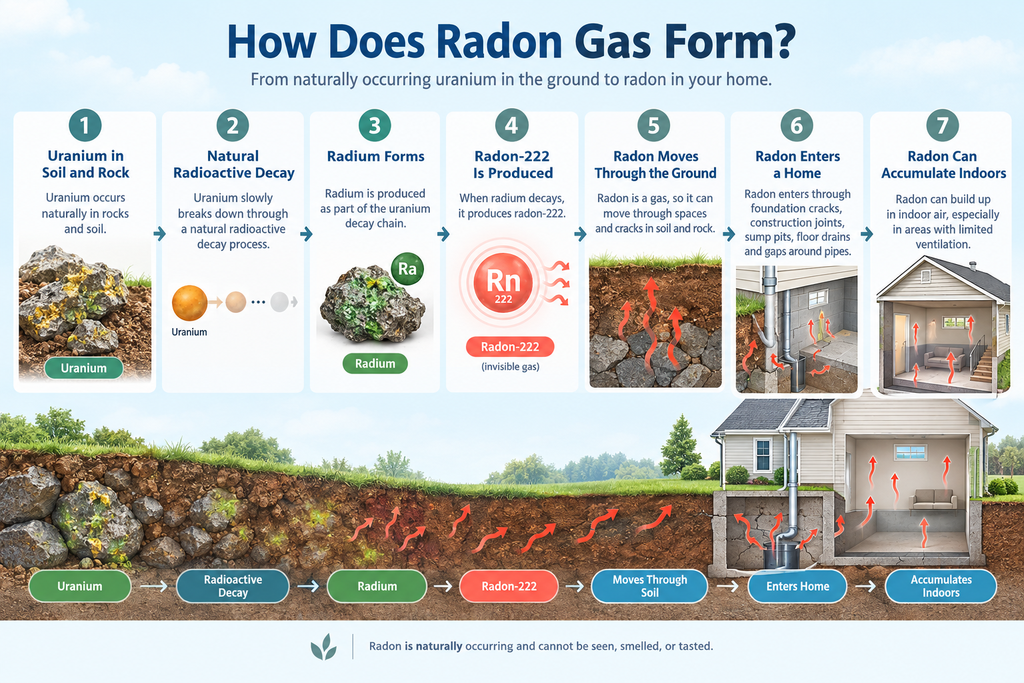
If you wonder where does radon come from, the answer starts deep in the Earth’s crust. Uranium, thorium, and radium are heavy radioactive elements found in the ground. These unstable materials slowly decay over time, randomly split apart, and release energy and radiation. As radium-226 decays, it turns into radon-222 gas, a radioactive gas that escapes from the ground and can move into the air.
So, what causes radon gas and where is radon found? Radon is naturally produced deep underground and can be found in soil, rocks, and air. As radon decays, it forms further radioactive particles that emit radiation. These particles can become a concern for human health, especially when radon enters enclosed spaces and builds up over time.
How Does Radon Get Into a House?
It usually starts with soil gas beneath the building. As radon moves through the underlying soil, it can find pathways into the home through cracks in foundations, concrete slabs, construction joints, floor-wall joints, and other openings. Even small gaps around pipes, floor drains, or sump pits can allow radon to enter. This is why radon get into a house through cracks is an important question when looking at possible radon pathways.
A basement can have several entry points because it is close to the ground. Radon may move through crawl spaces, exposed soil, open sumps, drain tile, mortar joints, block walls, and loose-fitting pipe penetrations. Concrete is not an absolute barrier either; cracks, joints, and pores can provide pathways for soil gas. In some homes, well water or building materials may also contribute to indoor radon. When ventilation is minimal, radon can accumulate indoors instead of being diluted like outdoor radon.
Can You Smell or See Radon Gas?
A home can look completely normal while still having elevated radon levels. Radon is an invisible radioactive gas with no colour, smell, or taste, so you cannot see, smell, or taste it in the air. If you are wondering what radon gas looks like, the simple answer is that there is nothing visible to notice.
That also means your senses cannot tell you whether indoor radon is present or whether it has reached harmful levels. Unlike some household problems, radon has no noticeable indicators that homeowners can rely on. It can move through soil and rocks and accumulate inside buildings without being noticed. Radon testing with special equipment is therefore needed to detect its presence and determine the radon level and potential exposure.
Is Radon Gas Dangerous?
Yes, long-term exposure to elevated radon levels can increase the risk of lung cancer. Radon is a radioactive substance that emits radiation. Over time, this radiation can cause cell damage, creating a health risk. In simple terms, what does radon gas do? The concern is not an immediate reaction, but the damage that can occur with continued radon exposure.
Its main established health concern is lung cancer rather than an immediate illness. For people who spend a lot of time in their homes, reducing prolonged exposure is especially important. The risk is also greater for smokers and former smokers, because radon and cigarette smoking can have synergistic effects on lung cancer risk. So, what happens if radon is in your home depends largely on the radon level and how long people are exposed.
Where Does Radon Collect in a Home?
The lowest levels of a home are the main places to check. Basements, cellars, crawl spaces, and ground-floor rooms are closest to the ground and may have direct contact with soil and soil gas, the main cause of many radon problems. A basement with a large surface area touching soil can have more opportunities for radon to enter through cracks in concrete, floor-to-wall joints, control joints, and other foundation openings. But is radon only found in basements? No. Homes without basements, including slab-on-grade homes, can also have elevated radon levels when openings allow soil gas to enter.
In homes with a crawl space, a vacuum effect from interior air pressure can draw radon gas from the crawl space into the home. The same principle can affect **manufactured homes.
How Do You Know If Your House Has Radon?
If you are asking how do you know if your house has radon, testing is the only way to find out because radon cannot be seen, smelled, or felt. Professional radon testing by a licensed professional or radon specialist team can provide a more reliable assessment of the radon level, especially when you want an accurate reading for your home and family. Testing the basement or lowest living area is a practical place to start.
A do-it-yourself radon test kit from a hardware store can also be used as an inexpensive option, but it should not replace professional testing when you want greater confidence in the result. The EPA uses 4 pCi/L as the action level, so knowing your home’s actual radon level helps determine whether further steps, such as a radon reduction system, are needed.
What Should You Do If Your Home Has Radon?
If you are wondering because your home test kit shows elevated radon levels, the next step is to have the home professionally tested to confirm the radon level and determine what action is needed. There is no known safe level of radon exposure, but reducing radon can reduce the risk of harmful health effects, including lung cancer. The EPA recommends taking action at 4 pCi/L, while some homeowners may choose to reduce levels below that when practical.
When elevated levels are confirmed, the next step is to contact a qualified professional or certified contractor for further testing and radon mitigation system installation. They can assess how radon is entering the home, recommend the appropriate radon reduction system, and install it to reduce radon entering the living space. Professional testing followed by proper mitigation can help improve indoor air quality, home safety, and reduce long-term radon risk. If you are buying a new home, radon-resistant construction and features that prevent or minimize radon entering can also help reduce future radon risk.
Conclusion
Radon is an unseen danger that can enter any home from the ground and soil and spread through a house without any smell or visible sign. Understanding what radon gas is made of, where it comes from, and how it can affect health helps you recognize the potential risk to your family. You cannot know that radon is present simply by looking at your home or noticing how the air feels.
The important thing is simple: you cannot see radon, smell it, or know it is there without testing. Long-term exposure can increase health risks, which is why knowing your radon levels through proper testing is essential. If radon levels are elevated, finding out early gives you the opportunity to reduce the risk and make your home safer for your family.
Frequently Asked Questions
How Does Radon Gas Form?
Radon gas forms in the ground when uranium, thorium, and radium slowly decay. These heavy, radioactive elements break apart over time and release energy and radiation. When radium-226 decays, it turns into radon-222 gas. This radioactive gas can escape from the ground, move into a home, and enter the indoor air.
What Are the Health Risks Associated With Radon Gas Exposure?
Breathing radon gas for long periods can expose you and your family to radioactive particles that may harm the lungs and damage cells over time. Continued exposure can increase the risk of lung cancer and the development of malignant tumors. The concern is that radon exposure usually has no immediate warning signs; symptoms such as a persistent cough, chest pain, or unexplained weight loss may not become noticeable until lung cancer has reached a more advanced stage.
How Can I Test for Radon Gas in My Home?
Short-term kits are an inexpensive and quick way to see if you have radon or not. If radon is present, do not rely on the kit alone for knowing the exact levels; for proper testing and accurate results, contact a professional.
Can I Trust a Radon Test Kit?
Yes, a radon test kit can be an inexpensive, good way of knowing whether your home may have radon and whether it is safe or not. But for accurate measuring and to find the exact radon levels, it is better to hire a professional who can determine whether a reduction system is needed.
What Are the Main Entry Points of Radon?
The main entry points are where the home meets the soil, especially gaps, openings, and pores that connect the ground to the living space. Radon can enter through basements and crawl spaces, where these pathways may allow soil gas to move indoors. Checking these areas is important when testing for exact levels of radon in a home.